


The Artificial Intelligence Act (AI Act) establishes a harmonized legal framework for the development, placing on the market, and use of artificial intelligence systems within the European Union. Among its requirements, some directly concern the accessibility of information and interfaces associated with AI systems.
These obligations arise in particular in two situations:
- where AI systems are subject to transparency obligations;
- where AI systems are classified as high-risk.
In such cases, the information provided to users or operators must be accessible, including to persons with disabilities.
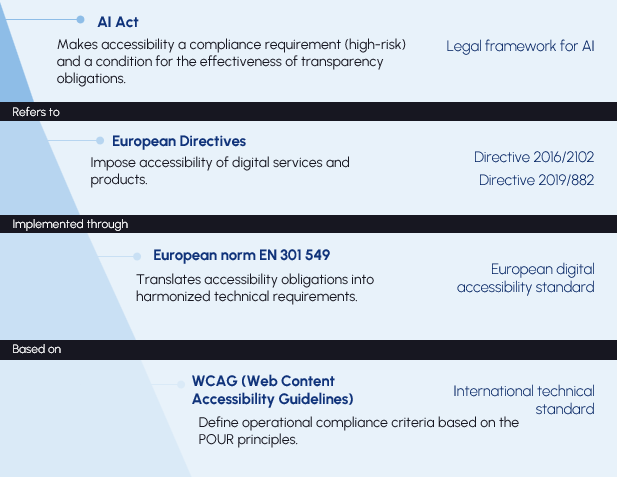
However, the regulation itself does not define the technical standards required to ensure such accessibility. Instead, it refers to the existing European framework on digital accessibility, primarily composed of Directives (EU) 2016/2102 and (EU) 2019/882.
These directives themselves rely on European and international technical standards, notably the EN 301 549 standard “Accessibility requirements for ICT products and services” and the Web Content Accessibility Guidelines (WCAG).
Understanding accessibility obligations applicable to AI systems therefore requires analyzing this broader regulatory framework.
I. European Accessibility Directives
1. Directive (EU) 2016/2102: Accessibility of public sector websites and mobile applications
Directive (EU) 2016/2102 aims to harmonize accessibility requirements applicable to digital services provided by public sector bodies.
It applies to websites and mobile applications of public sector entities. It covers in particular:
- textual and non-textual content;
- downloadable documents;
- forms and online services;
- multimedia content.
Article 4 requires Member States to ensure that websites and mobile applications are designed to be: perceivable, operable, understandable, and robust.
The directive establishes a presumption of conformity where digital services comply with harmonized technical standards, notably EN 301 549.
2. Directive (UE) 2019/882 : the European Accessibility Act
Directive (EU) 2019/882 extends accessibility requirements to a wide range of digital products and services in the private sector.
It applies to digital products, including:
- consumer terminal equipment with interactive computing capabilities;
- self-service terminals;
- e-readers;
- certain equipment used to access electronic communication services;
- equipment used to access audiovisual media services.
It also applies to several services, including:
- electronic communication services;
- services providing access to audiovisual media;
- passenger transport services (air, rail, bus, or waterborne);
- consumer banking services;
- e-books;
- e-commerce services.
Annex I of the directive provides that products and services must be designed to ensure optimal use by persons with disabilities. Interfaces and information must, in particular, be perceivable, operable, understandable, and robust.
Key implications for products:
- accessible design of the product and its interface
- accessible user information and instructions
- compatibility with assistive technologies
- technical documentation, EU declaration of conformity, and CE marking
Key implications for services:
- accessibility of digital interfaces (websites, applications, service interfaces)
- service information available in accessible formats
- accessibility of support services (helpdesk, customer support)
- documentation describing compliance with accessibility requirements
II. Applicable Technical Accessibility Standards
1. EN 301 549 – Accessibility requirements for ICT products and services
The European standard EN 301 549 defines the technical requirements used to assess the accessibility of information and communication technologies. It covers, in particular: websites, mobile applications, software, electronic documents, and certain user interfaces.
Compliance with this standard generally allows demonstration of conformity with accessibility requirements set out in European directives.
2. Web Content Accessibility Guidelines (WCAG)
The WCAG are international guidelines developed by the World Wide Web Consortium (W3C) to make digital content accessible. They are based on four fundamental principles, commonly referred to by the acronym POUR:
- Perceivable: information must be presented in ways that users can perceive
- e.g., text alternatives for images, captions for audio and video content, sufficient visual contrast
- Operable: interfaces must be usable through different interaction modes
- e.g., keyboard navigation and compatibility with assistive technologies
- Understandable: information and interfaces must be easy to understand
- e.g., clear language, explicit instructions, predictable interface behavior
- Robust: content must be robust enough to be reliably interpreted by different browsers and assistive technologies
WCAG define testable success criteria organized into three levels of conformance: A, AA, and AAA. In practice, level AA is generally the level targeted by European regulations.
III. AI Focus: Accessibility Requirements under the AI Act
The AI Act integrates accessibility as a cross-cutting requirement applicable to certain AI systems. These obligations mainly concern: 1) high-risk AI systems and 2) certain systems subject to transparency obligations.
1. Accessibility of high-risk AI systems
Article 16 sets out the obligations of providers of high-risk AI systems.
Point (l) provides that:
providers must ensure that high-risk AI systems comply with accessibility requirements laid down in Directives (EU) 2016/2102 and (EU) 2019/882.
Accessibility therefore constitutes a compliance requirement of the system, to be met in the context of its placing on the market or putting into service.
In practice, this implies that providers must notably:
- integrate accessibility requirements from the design stage of the AI system;
- ensure accessibility of user interfaces and interactions;
- guarantee compatibility with assistive technologies;
- document these elements in the system’s technical documentation.
This approach is reinforced by Recital 80, which emphasizes that accessibility requirements should be integrated from the design phase (“accessibility by design”)..
2. Accessibility within transparency obligations
Article 50 of the AI Act also establishes transparency obligations for certain AI systems, notably those that:
- interact with natural persons (e.g., chatbots);
- generate or manipulate content (text, image, audio, or video);
- use emotion recognition or biometric categorization systems;
- generate deepfakes.
Paragraph 5 of Article 50 states that:
information intended for natural persons must be provided in a clear and recognizable manner, at the latest at the time of first interaction or exposure, and must comply with applicable accessibility requirements.
This implies that transparency notifications must be accessible to persons with disabilities and users of assistive technologies.
In practice, such information must be:
- perceivable (e.g., text alternatives, captions, sufficient contrast)
- operable (accessible navigation, compatible with assistive technologies)
- understandable (clear language, consistent and predictable interfaces)
- robust (interpretable by assistive technologies)
These requirements align with accessibility principles defined in European and international technical standards, notably EN 301 549 and WCAG.
IV. Accessibility: A Governance Issue for AI
With the AI Act, accessibility becomes a compliance requirement for artificial intelligence systems.
Organizations developing or deploying AI systems must now integrate these requirements into their regulatory compliance processes, notably:
- in interface design;
- in transparency notifications;
- in system documentation.
In other words, accessibility is no longer limited to design or user experience considerations: it becomes a core element of AI governance.
Implementing Accessibility Over Time
Integrating accessibility is not limited to one-off adjustments. It requires the ability to identify, monitor, and demonstrate compliance throughout the lifecycle of AI systems.
This notably involves structuring internal practices to:
- link regulatory requirements to relevant AI systems;
- translate accessibility principles into operational criteria;
- document design choices and implemented measures;
- ensure continuous and auditable monitoring.
👉 Discover the Naaia platform, designed to support organizations in the operational implementation of AI Act compliance, including the integration of accessibility requirements into the governance and management of AI systems.