
Build and maintain trusted AI systems at scale
Strengthen confidence in your AI systems through governance, transparency, security, and continuous oversight.
Évaluez votre conformité
Digital trust is becoming a business-critical requirement
-
 Customers, regulators, employees, and partners increasingly expect transparency on how AI systems are designed, governed, and monitored.
Trust in AI cannot be assumed anymore
-
 Organizations rely on a growing mix of internal models, third-party providers, APIs, and generative AI tools—creating new dependencies and risks.
AI ecosystems are becoming more complex
-
 Risk, security, compliance, and business teams often operate in silos, making it difficult to maintain a unified and consistent governance approach.
Fragmented governance weakens trust
-
 Digital trust is not a one-time assessment. Organizations must continuously monitor AI systems, controls, risks, and compliance posture over time.
Trust requires continuous oversight
Create a trusted foundation for enterprise AI
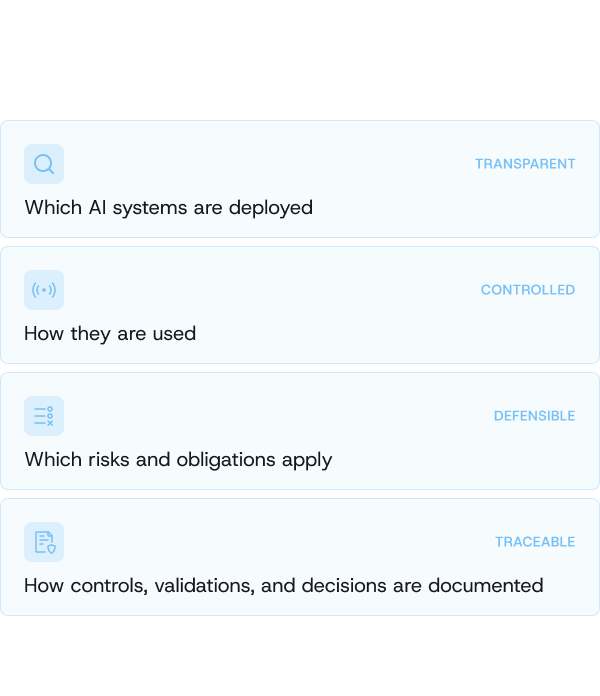
Naaia enables organizations to operationalize digital trust by combining AI governance, compliance, risk management, and operational oversight within a unified platform. By centralizing AI assets, governance workflows, controls, and evidence, the platform provides a transparent, traceable, and defensible AI operating framework across business units, jurisdictions, and technologies. This creates a clear chain of accountability across legal, risk, compliance, security, and technical teams—strengthening governance and reinforcing trust at scale.
Continuously monitor trust signals across your AI ecosystem
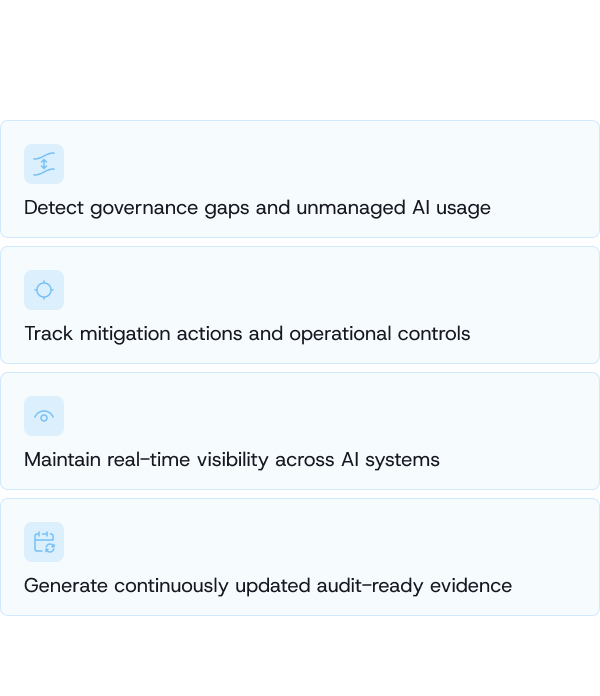
Digital trust requires continuous oversight as technologies, risks, and regulations evolve. Naaia enables organizations to continuously monitor trust signals, AI risks, governance controls, and compliance posture across their entire AI ecosystem. Through integrated workflows and dynamic regulatory mapping, organizations can ensure that trust remains operational, measurable, and continuously aligned with evolving requirements.
Get a demo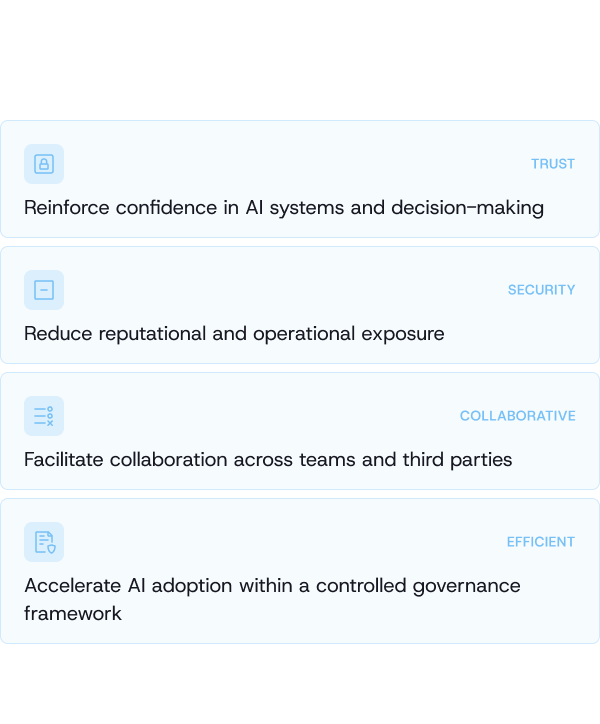
Strengthen confidence across stakeholders
Naaia helps organizations demonstrate responsible and trustworthy AI practices to regulators, customers, employees, executive teams, and business partners.
Operationalizing digital trust becomes a strategic lever to scale AI responsibly while maintaining confidence across the entire organization and its ecosystem.
By embedding transparency, accountability, and traceability into AI governance processes, organizations can:
With Naaia
Establish a trusted AI governance framework
Create clear governance structures, accountability mechanisms, and oversight processes across your AI ecosystem.
Increase transparency and traceability
Maintain full visibility into AI systems, decisions, risks, controls, and compliance evidence.
Continuously monitor trust and compliance
Track risks, controls, and regulatory obligations in real time as your AI landscape evolves.
Build confidence across stakeholders
Demonstrate responsible AI practices to regulators, customers, employees, and partners.
Trusted by those who build with AI

Naaia enabled us to move toward a more value-driven approach to AI governance. Beyond compliance, the platform helps us prioritize AI initiatives based on business impact, risk, and strategic value.

Colas naturally selected Naaia for its intuitive user experience, as well as its educational and thought-leadership approach to simplifying complex AI topics. A truly collaborative framework was established throughout the project, driving stronger team engagement, seamless adoption, and operational efficiency.

We chose Naaia for its clear framework to inventory and govern our AI initiatives. We particularly appreciate the combination of its user-friendly tools, which make compliance more accessible, and the supportive guidance from their team.

Naaia helped us operationalize AI Act readiness across our regional authority’s services with a clear and trusted governance framework. The platform improved collaboration between departments and gave us the visibility needed to scale AI responsibly.

Naaia provided the structured, collaborative approach our organization needed to turn complex regulatory requirements into clear, actionable steps for our teams. As a provider of high-risk AI systems, we relied on Naaia as a trusted partner, whose genuine support enabled us to rapidly operationalize our compliance program.
Learn about other use cases
Frequently asked questions
-
How can organizations demonstrate AI trustworthiness to regulators, customers, and partners?
Demonstrating AI trustworthiness requires moving beyond internal assurance to external evidence. For regulators: maintaining complete technical documentation, risk assessments, and incident logs that can be produced on request. For customers: publishing an AI policy statement, providing clear explanations of how AI systems affect their experience, and enabling meaningful opt-out where required by law. For partners: pursuing third-party certification (ISO/IEC 42001) and sharing governance summaries as part of vendor qualification processes. Organizations that combine internal governance discipline with external transparency are best positioned to build lasting stakeholder trust.
-
What does it mean to operationalize digital trust for AI systems?
Operationalizing digital trust for AI means putting in place the concrete processes and infrastructure that allow an organization to consistently demonstrate that its AI systems behave as intended, are governed responsibly, and can be held accountable. This includes: maintaining a live inventory of AI systems with their approved specifications, logging AI-driven decisions in a retrievable audit trail, documenting human oversight procedures, and establishing incident response protocols for unexpected or harmful outputs. Digital trust is not a state to be achieved once — it is a continuous practice sustained through governance infrastructure, organizational culture, and proactive stakeholder communication.
Naaia helps organizations operationalize digital trust by centralizing AI governance, compliance, risk management, and oversight workflows within a unified platform. This enables continuous visibility, traceability, and control across AI systems. -
Why is accountability essential for trustworthy AI?
Accountability in AI means that every AI-driven decision can be traced back to an identifiable decision point, a responsible human authority, and a documented rationale — enabling redress when things go wrong. Without accountability, organizations cannot meet their legal obligations under the EU AI Act (which requires human oversight for high-risk systems) or respond credibly to incidents. Practically, accountability requires assigning named owners to each AI system, maintaining logs of consequential AI decisions, and establishing clear escalation procedures. Organizations that embed accountability into their AI governance from the outset avoid the far more costly process of reconstructing it after a regulatory challenge or public incident.
-
How can organizations demonstrate responsible AI practices?
Demonstrating responsible AI requires both internal discipline and external communication. Internally: conduct systematic AI risk assessments, maintain audit-ready documentation, train staff on AI ethics and compliance, and establish a process for identifying and addressing AI-related harms. Externally: publish an AI principles statement aligned with recognized frameworks (EU AI Act, UNESCO AI Ethics), pursue ISO/IEC 42001 certification, participate in industry transparency initiatives, and communicate proactively with stakeholders about how AI is — and is not — used. Organizations that treat responsible AI as a reputational asset, not just a compliance requirement, are better positioned in competitive markets where governance is increasingly an investor and customer priority.