
Navigating a multi-layered governance landscape
With Naaia, align your AI systems with China’s multi-layered regulatory framework, from generative AI rules and algorithmic governance to content labeling and deepsynthesis.
Assess your complianceScope, framework and regulatory landscape in China
China has established a comprehensive and multi-layered AI regulatory framework applicable across mainland China. Rather than a single law, the system is structured around several key regulations targeting specific AI use cases, including generative AI (IMMGAI), algorithmic recommendation systems, deep synthesis technologies and anthropomorphic interactive AI systems.
The framework directly concerns multiple stakeholders across the value chain, including service providers, deployers (users), technical support providers, and application distribution platforms.
This AI regulatory framework operates in close complementarity with China’s broader legal regime, notably the Cybersecurity Law, Data Security Law, and Personal Information Protection Law.
Core principles and risk controls across AI regulations
Chinese AI regulations embed strict principles governing content, ethics, and societal impact. Generative AI systems must adhere to core socialist values and avoid producing illegal or harmful content, including misinformation, extremism, or content threatening national security.
Strong non-discrimination requirements apply throughout the AI lifecycle, alongside obligations to protect intellectual property, personal data, and individual rights such as privacy and reputation.
Across regulations, operators must implement content moderation, ensure transparency, and maintain accuracy and reliability of AI-generated outputs, reflecting a governance model focused on control, stability, and societal alignment.
Compliance obligations, transparency and enforcement mechanisms
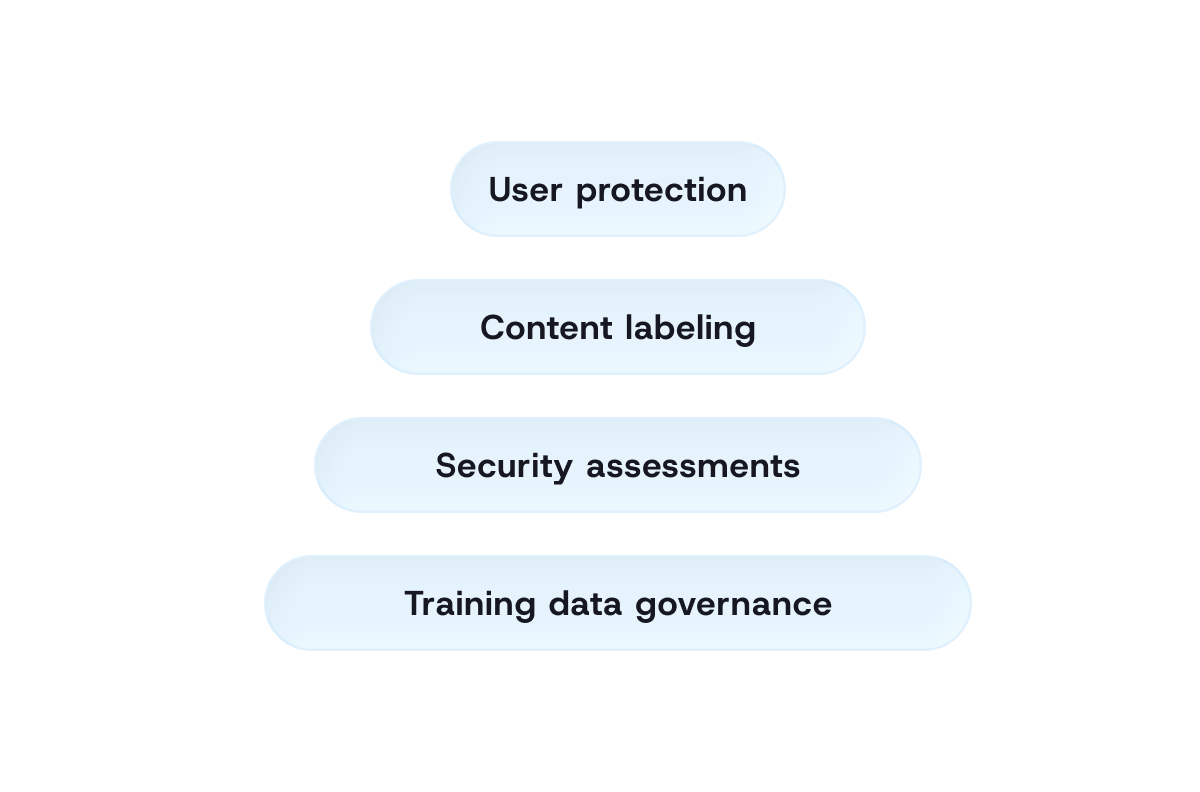
China imposes extensive operational obligations, including content labeling, user protection, training data governance, and security assessments.
A dedicated 2025 framework introduces strict labeling and traceability requirements for AI-generated content, including visible disclosures and machine-readable identifiers.
Deep synthesis and algorithmic systems must ensure user verification, risk mitigation, and technical security audits.
Anthropomorphic interactive AI systems are also subject to specific requirements aimed at ensuring transparency in human-machine interactions and mitigating the risks associated with such systems.
Enforcement is centralized under authorities such as the Cyberspace Administration of China (CAC), with local implementation ensuring continuous supervision.
Non-compliance may lead to warnings, service suspension, fines (up to 200,000 RMB), or even administrative or criminal liability depending on severity.
With Naaia
Map your regulatory exposure in China
Identify which regulations apply to your AI systems (IMMGAI, algorithmic recommendation, deep synthesis, or labeling rules) based on your use cases and deployment.
Embed China-specific AI principles and controls
Integrate requirements such as non-discrimination, content moderation, and alignment with core societal values into your AI governance.
Operationalize content labeling and traceability
Implement mandatory labeling, watermarking, and technical traceability mechanisms for AI-generated content across platforms.
Prepare for centralized and continuous enforcement
Align your compliance with CAC-led oversight and anticipate multi-level enforcement, from corrective actions to financial and legal penalties.

Learn about other regulations & norms


Frequently asked questions
-
How does China regulate artificial intelligence, and what are the key laws international companies must know?
China has developed one of the world’s most comprehensive AI regulatory frameworks through three primary regulations:
(1) the Algorithm Recommendation Regulations (2022), governing personalization and recommendation systems;
(2) the Deep Synthesis Regulations (2022), covering AI-generated content including deepfakes and synthetic media; and
(3) the Generative AI Measures (2023), regulating large language models and generative AI services.
International companies serving Chinese users or operating in China must assess which regulations apply to their AI use cases, register applicable AI services with the Cyberspace Administration of China (CAC), and implement content security review processes. -
What obligations do international companies have under China's AI Algorithm Recommendation Regulations?
China’s Algorithm Recommendation Regulations impose several obligations on providers of recommendation systems targeting Chinese users: clear disclosure that algorithmic recommendations are being used, opt-out mechanisms for personalized recommendations, prohibition of unfair pricing or discriminatory treatment through algorithms, and special protections for minors. For foreign companies, the extraterritorial reach of these regulations depends on whether the service is actively offered to mainland China users. Companies that fall within scope must register their recommendation services with the CAC and undergo periodic security assessments.
-
How can organizations operationalize AI compliance in China?
Operating in compliance with China’s AI regulatory framework requires three parallel workstreams. First, regulatory mapping: identify which of the three main regulations apply to each AI use case, as obligations differ significantly across recommendations, generative AI, and deep synthesis. Second, registration and approval: register applicable AI services with the CAC, including required technical documentation and security assessments. Third, ongoing governance: implement content review processes, user rights management (opt-outs, transparency notices), and data localization controls. Given the pace of regulatory development in China, a dedicated monitoring process for new guidance from the CAC and MIIT is essential.