
Secure AI deployment through full visibility, compliance & risk management
Manage your AI risks & compliance with our end-to-end, agnostic, next-generation platform that operationalizes regulatory, normative & client-specific compliance.
Évaluez votre conformité
Building trust while facing unprecedented challenges with AI
-
 Enlarged dependance to technological supply chain (models, APIs, platforms…)
-
 Multi-layered, multi-jurisdictional
supply chain
Multi-layered, multi-jurisdictional
supply chain
A complex AI supply-chain
-
 Fast diffusion of AI systems across the organisation, impacting the qualification capacity and security of AI products
-
Adoption across all business functions
-
 Contradictory injunction to decision makers, implement AI fast but in the right way
Widespread adoption of AI
-
 Fragmented horizontal & vertical AI regulations worldwide with over 2,000 ongoing legislative processes
-
 Numerous regulations already enforced across all regions: Europe, US, China, South Korea, Japan…
Rapid expansion of AI regulations
Naaia, the end-to-end platform to manage your risks
Naaia turns regulatory & non regulatory frameworks into operational action, automating and simplifying risk management in a technology-agnostic, ecosystem-integrated way.
Get a demoWith Naaia
Facilitate adoption of responsible AI Practices
Through controlled costs and timeline, Naaia supports you into the deployment of Trusted AI.
Support full AI compliance overtime
The platform features will bring the organisation from mapping all use cases to building the compliance evidence, use case by use case.
Ensure practical & scalable integration of all frameworks
From regulations to international standards, including customer -specific frameworks.
Support the teams skills building
The AI agents and our Naaia Academy platform ensures the training and competencies building of the teams.
Trusted by those who build with AI

Naaia enabled us to move toward a more value-driven approach to AI governance. Beyond compliance, the platform helps us prioritize AI initiatives based on business impact, risk, and strategic value.

Colas naturally selected Naaia for its intuitive user experience, as well as its educational and thought-leadership approach to simplifying complex AI topics. A truly collaborative framework was established throughout the project, driving stronger team engagement, seamless adoption, and operational efficiency.

We chose Naaia for its clear framework to inventory and govern our AI initiatives. We particularly appreciate the combination of its user-friendly tools, which make compliance more accessible, and the supportive guidance from their team.

Naaia helped us operationalize AI Act readiness across our regional authority’s services with a clear and trusted governance framework. The platform improved collaboration between departments and gave us the visibility needed to scale AI responsibly.
Naaia provided the structured, collaborative approach our organization needed to turn complex regulatory requirements into clear, actionable steps for our teams. As a provider of high-risk AI systems, we relied on Naaia as a trusted partner, whose genuine support enabled us to rapidly operationalize our compliance program.
Platform capabilities
Build your centralized registry for all AI products
- Full visibility over the AI systems, models and components.
- Bulk imports of your AI products existing list through Excel/CSV.
- Connect with your cybersecurity, data catalog or SAM solutions to automate building your AI/GenAI portfolio.
Platform capabilities
Build your centralized registry for all AI products
- Full visibility over the AI systems, models and components.
- Bulk imports of your AI products existing list through Excel/CSV.
- Connect with your cybersecurity, data catalog or SAM solutions to automate building your AI/GenAI portfolio.
Identify and classify your AI risks
- Assess regulatory & non regulatory frameworks continuously.
- Built-in qualification engine for automated risk scoring.
- Real-time alerts and risk evolution tracking.
Turn risks into structured remediation plans
- Convert compliance requirements into actionable tasks.
- Track progress across teams and frameworks.
- Workflow automation for remediation actions.
Measure, prove and report your compliance
- Generate audit-ready reports in one click.
- Track compliance KPIs and risk indicators in real time.
- Share stakeholder-tailored dashboards instantly.
Nouveau titreA dedicated AI viglance portal
- Streamlined Post-Market Monitoring : meet regulatory obligation with automated oversight.Premier point…
- Engages the ecosystem : connect suppliers, distributors and users in a collaborative vigilance network.
- Real-time alerts & communication : accelerate risk management through instant notifications and direct exchanges.
Move faster with Naaia’s AI Agents
We are developping new AI capabilities continuously, all in the mindset of removing the compliance and risk management burden from the teams as much as possible.
Interoperable by essence
Naaia’s architecture is built on a robust data pipeline and ingestion layer that enable the integration of multiple data sources to power its business capabilities with reliable, contextualized, and actionable data.
With native integrations such as Wiz and ServiceNow, Naaia seamlessly leverages data already managed by organizations’ IT and cybersecurity teams. Applications, AI models, AI components, governance data, and risk signals can be automatically synchronized, helping organizations streamline AI governance, qualification, and oversight processes through a single platform.
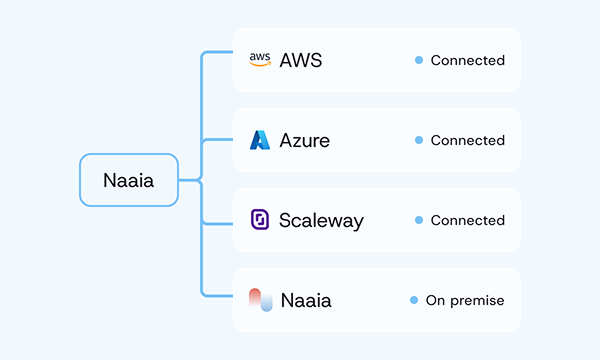
Deploy anywhere
Naaia's platform can be delivered as a SaaS platform or an on-prem solution depending on the customer needs. Naaia is cloud-agnostic and is already hosted on AWS, Azure and Scaleway.
Get a demoLearn about other services
Naaia Advisory
We provide operational and pragmatic expertise in managing risks associated with AI systems, tailoring our hands-on know-how to your specific context and needs.
Naaia Academy
We provide our clients with a dedicated LMS to train and upskill their teams on AI, with a particular focus on responsible AI.
Frequently asked questions
-
What are the main AI governance challenges organizations face today?
Organizations face five core AI governance challenges in 2026:
(1) incomplete visibility into all AI systems in use, including shadow AI deployed without IT oversight;
(2) regulatory fragmentation across multiple jurisdictions with overlapping requirements;
(3) organizational silos between legal, risk, and technical teams;
(4) the speed of AI development outpacing governance processes; and
(5) the lack of standardized evidence formats for regulatory audits.
Addressing these challenges requires both a governance framework — such as ISO/IEC 42001 — and a platform capable of operationalizing it at scale. -
Why do enterprises need full visibility into their AI supply chain to comply with the EU AI Act?
The EU AI Act imposes specific obligations on organizations that deploy AI systems developed by third-party providers (Articles 25 and 28). Without full visibility into the AI supply chain — knowing which models, APIs, and vendors power each AI-enabled process — organizations cannot accurately classify risk levels, assign accountability, or demonstrate compliance. A single untracked third-party AI component can expose an organization to significant regulatory liability, particularly if that component contributes to a high-risk AI system.
-
How can organizations manage AI compliance at scale across multiple jurisdictions?
Managing AI compliance across multiple jurisdictions requires three capabilities: a unified AI system inventory that maps each asset to the applicable regulations, a cross-framework compliance engine that avoids duplicating documentation efforts, and automated monitoring that tracks regulatory changes in real time. Organizations operating under the EU AI Act, the TRAIGA, and Asian AI regulations simultaneously need a platform that centralizes governance workflows rather than maintaining separate compliance programs per jurisdiction.
-
What does it mean for an AI governance platform to be technology-agnostic?
A technology-agnostic AI governance platform can govern any AI system regardless of the underlying technology, vendor, or deployment model — whether it’s a proprietary algorithm, an open-source model, a third-party API, or a large language model. This matters because most organizations use AI from multiple providers. A technology-agnostic approach ensures that governance processes (risk assessment, documentation, monitoring) apply uniformly across the entire AI portfolio, preventing blind spots in compliance coverage.