
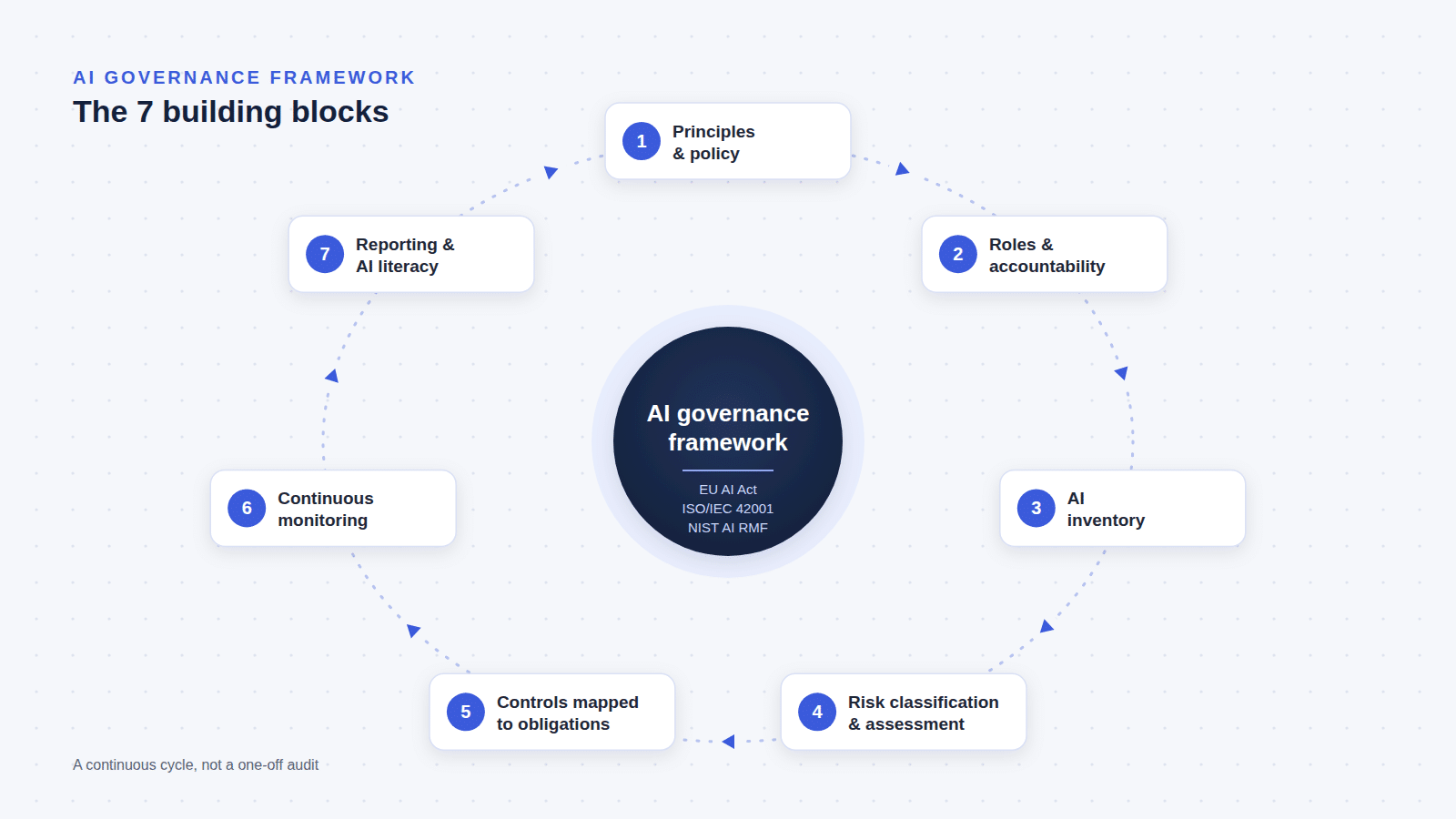
An AI governance framework is the set of policies, roles, processes and controls an organization uses to make sure every AI system it builds, buys or deploys is safe, lawful and aligned with its values, from the first idea to retirement. A good one doesn’t just satisfy regulators. It gives your teams the confidence to scale AI faster, because the rules of the road are clear.
This guide is for compliance, risk and legal leaders who need to design that framework, or turn an existing policy into something that works day to day. It covers the seven building blocks every framework needs, how the major reference frameworks fit together, and a six-step roadmap to get from paper to practice.
What is an AI governance framework?
An AI governance framework defines who decides about AI in your organization, what rules AI systems must follow, and how you prove those rules are being followed, continuously.
It’s worth separating three terms that are often used interchangeably:
- AI governance policy: the written statement of principles and rules (what is allowed, what is prohibited, what requires approval).
- AI governance framework: the full operating model around that policy: roles, inventory, risk assessment, controls, monitoring and reporting.
- AI governance platform: the software that runs the framework at scale, so it doesn’t live in spreadsheets and email threads.
A policy without a framework is a statement of intent. A framework without tooling tends to break the moment your AI portfolio grows past a few dozen systems.
Why compliance teams need one now
AI adoption has outpaced most organizations’ ability to oversee it. Business units adopt generative AI tools, vendors embed models into software you already own, and data science teams ship models to production. Each one creates obligations.
Meanwhile, the regulatory map is filling in fast. More than 100 countries are engaged in AI-related regulatory processes, many of them inspired by the EU AI Act. For any organization that places AI systems on the EU market or uses them in the EU, the AI Act timeline is now concrete, following the Digital Omnibus amendments that entered into force in July 2026:
| Date | What applies |
|---|---|
| 2 February 2025 | Prohibited AI practices; AI literacy measures |
| 2 August 2025 | Obligations for general-purpose AI (GPAI) models |
| 2 August 2026 | Transparency obligations (e.g., disclosing AI interactions) |
| 2 December 2026 | Marking of AI-generated content for systems already on the market |
| 2 December 2027 | Stand-alone high-risk AI systems (Annex III) |
| 2 August 2028 | High-risk AI systems embedded in regulated products (Annex I) |
The high-risk deadlines moved, but they weren’t cancelled. The work they require (inventory, classification, risk management, documentation, human oversight) takes many months to put in place across a large organization. Starting now is what turns compliance into an advantage rather than a scramble.
There’s also a performance case. Gartner found that organizations deploying an AI governance platform are 3.4 times more likely to achieve high effectiveness in AI governance. Governance done well is what lets you say “yes” to AI projects with confidence.
The reference frameworks, and how they fit together
You don’t need to invent your AI governance framework from scratch. Most organizations anchor theirs on a combination of the following:
| Framework | Type | What it gives you |
|---|---|---|
| EU AI Act | Binding regulation | Risk-based obligations by role (provider, deployer, importer, distributor), from prohibited practices to high-risk requirements |
| ISO/IEC 42001 | Certifiable international standard | A management system for AI (AIMS): policy, roles, risk treatment, controls and continual improvement |
| NIST AI RMF | Voluntary framework (US) | Four functions (Govern, Map, Measure, Manage) for identifying and treating AI risk |
| GDPR | Binding regulation | Lawful basis, data protection impact assessments and rights around automated decision-making |
| Internal charters and policies | Your own rules | Ethics principles, cybersecurity policies and sector-specific requirements |
These frameworks overlap heavily. An AI inventory, a risk assessment and human oversight controls show up in almost all of them. The most efficient approach is to map each obligation once to a shared set of controls, then show how each control satisfies each framework. That way, one piece of evidence can serve several requirements, instead of each regulation getting its own spreadsheet and its own audit.
The 7 building blocks of an AI governance framework
1. Principles and policy
Start with a short set of principles your leadership will actually defend (for example: human oversight, transparency, fairness, security, accountability). Then translate them into a policy with concrete rules: which uses are prohibited, which need approval, which are low-risk and can move fast. Keep it readable. A policy nobody reads doesn’t govern anything.
2. Roles and accountability
Define who owns what. Most mature frameworks include:
- An AI governance committee (legal, compliance, risk, IT/security, data, business) that sets policy and arbitrates high-risk decisions.
- AI system owners in the business, accountable for each system through its lifecycle.
- Second-line reviewers (compliance, privacy, security) who assess and challenge.
- Clear escalation paths when a system changes risk level.
Map these roles against your obligations under the AI Act. Your duties differ depending on whether you’re the provider or the deployer of a system.
3. AI inventory
You can’t govern what you can’t see. A centralized registry of every AI system, model and component, including third-party and embedded AI, is the foundation of every other block. For each entry, record its purpose, owner, vendor, data used, users affected, lifecycle stage and your role under the AI Act.
The hard part is keeping it current. Inventories built once for an audit go stale within months.
4. Risk classification and assessment
Classify each system against the frameworks that apply to it: AI Act risk tier (prohibited, high-risk, transparency obligations, minimal), GDPR impact, and your internal risk appetite. Then assess the risks in depth: bias, robustness, security, explainability, privacy and supplier dependence. Classification decides how much governance a system needs, so it deserves rigor.
5. Controls mapped to obligations
For each risk and obligation, define the controls that address it: testing requirements, human oversight mechanisms, data quality checks, logging, transparency notices and vendor due diligence. Tie each control to the specific requirement it satisfies across the AI Act, ISO/IEC 42001, NIST AI RMF and your internal policies. This mapping is what makes your framework auditable.
6. Continuous monitoring
AI systems drift, vendors update models and regulations evolve. Point-in-time audits can’t keep up. Build in ongoing monitoring: performance and drift metrics, incident reporting, re-assessment triggers when a system’s use or data changes, and regulatory watch so new obligations flow into your controls automatically.
7. Documentation, reporting and literacy
Keep the evidence regulators and auditors will ask for: technical documentation, risk assessments, decisions and their justifications. Give leadership dashboards that show portfolio-level risk at a glance. And invest in AI literacy, so the people building and using AI understand the rules and why they matter.
How to build your AI governance framework: a 6-step roadmap
- Secure a mandate. Get an executive sponsor and a cross-functional committee. Frame the goal as enabling AI safely at scale, not just avoiding fines.
- Take stock. Build your first AI inventory, including shadow AI and AI embedded in vendor tools. Expect to find more than you thought.
- Choose your reference frameworks. Decide which regulations and standards apply (AI Act, GDPR, ISO/IEC 42001, NIST AI RMF, sector rules) and map their overlapping requirements to a single control set.
- Classify and prioritize. Risk-rate every system. Tackle potentially high-risk and customer-facing systems first.
- Operationalize. Turn controls into tasks with owners and deadlines, embedded in the tools your teams already use (ticketing, collaboration, identity and security systems).
- Monitor and improve. Set review cycles, track metrics and update the framework as regulations and your AI portfolio change. If you’re pursuing ISO/IEC 42001 certification, this continual improvement loop is a core requirement.
Common pitfalls to avoid
- Governance by spreadsheet. It works for ten systems. It breaks at a hundred, and the audit trail disappears with it.
- One project per regulation. Separate AI Act, GDPR and ISO workstreams duplicate effort and produce contradictory answers. Map once, comply many times.
- Treating it as a one-off audit. Compliance at a single point in time is out of date the day your vendor ships a new model.
- Forgetting third-party AI. Much of your exposure sits in tools you buy, not models you build. Vendor due diligence belongs in the framework.
- Leaving the business out. If governance is seen as the “department of no,” teams route around it. Make the low-risk path fast.
From framework on paper to framework in operation
This is where most AI governance frameworks stall: the principles are signed off, but the inventory, assessments and evidence live in scattered documents that no one can keep current.
Naaia was built to close that gap. As the first European AI Management System (AIMS®), Naaia turns your framework into operational, trackable action:
- Full visibility: a centralized registry of AI systems, models and components, with regulatory and internal risk assessment built in.
- Automated, continuous compliance: a multi-framework engine that maps the AI Act, GDPR, ISO/IEC 42001, NIST AI RMF and your own policies into actionable tasks, kept up to date as regulations change. No more point-in-time audits.
- Oversight that scales with your stack: 100+ connectors to the identity, IT, security, collaboration and AI testing tools you already use, with European hosting options for sovereignty-sensitive deployments.
Naaia is certified AFAQ ISO/IEC 42001 and ISO 27001, and was founded by lawyers and technologists who have spent their careers at the intersection of regulation and technology.
“Naaia helped us operationalize AI Act readiness across our regional authority’s services with a clear and trusted governance framework. The platform improved collaboration between departments and gave us the visibility needed to scale AI responsibly.”
— Nathalie Buffotot, Director of Data Compliance Projects, La Région Île-de-France
Frequently asked questions
What are the key components of an AI governance framework?
Seven building blocks: principles and policy, roles and accountability, an AI inventory, risk classification and assessment, controls mapped to obligations, continuous monitoring, and documentation, reporting and AI literacy.
What is the difference between an AI governance framework and an AI governance policy?
The policy states the rules. The framework is the operating model that applies them: who is responsible, how systems are inventoried and assessed, which controls apply and how compliance is monitored and evidenced over time.
Is ISO/IEC 42001 mandatory?
No. ISO/IEC 42001 is a voluntary, certifiable standard. But it gives you a recognized structure for your AI management system, and much of what it requires (risk management, documentation, oversight) overlaps with what the EU AI Act demands, so it’s an efficient backbone for your framework.
Does the EU AI Act apply to companies outside the EU?
Yes, if you place AI systems on the EU market or their outputs are used in the EU. US and other non-EU organizations with European customers, users or operations should factor the AI Act into their framework.
Who should own AI governance?
Ownership is usually shared: a cross-functional committee sets policy, business owners are accountable for individual systems, and compliance, legal, privacy and security provide second-line review. What matters most is that every AI system has a named owner.
Put your AI governance framework into action
A framework creates value only when it runs every day, across every system and every regulation that applies to you. See how Naaia turns your AI governance framework into continuous, automated compliance.
