
AI governance is the set of rules, roles, processes and tools that lets an organisation know which AI systems it uses, assess their risks and oversee them across their whole lifecycle. Done well, it doesn’t slow innovation down. It lets you deploy AI faster and with confidence, while meeting the requirements of the EU AI Act, ISO/IEC 42001, GDPR and your own internal policies.
Why AI governance has become a board-level priority
Organisations are caught between two opposing pressures. They need to move quickly to capture value from AI. At the same time, expectations on reliability, security, robustness and transparency keep rising.
Risks are multiplying
- AI is spreading faster than oversight: generative AI tools adopted by business teams, AI embedded in third-party software, and models built in-house.
- Dependence on suppliers is growing: models, APIs and platforms that the organisation doesn’t fully control.
- Trust is at stake: employees, customers and regulators all expect assurance about how AI is used.
The regulatory landscape is getting denser
More than 100 countries are now engaged in AI-related regulatory processes, most of them inspired by the EU AI Act. For UK organisations, this creates a layered picture.
AI governance in the UK: why the EU AI Act still matters
The UK has so far taken a principles-based approach to AI, relying on existing sector regulators rather than a single AI law. That doesn’t mean UK organisations can ignore the EU AI Act. The regulation has extraterritorial reach. It applies to providers placing AI systems on the EU market, and to providers and deployers outside the EU when the output of their AI systems is used in the EU.
In practice, a UK organisation is likely to fall within scope if it:
- sells AI-enabled products or services to EU customers;
- operates subsidiaries or teams in the EU;
- uses AI systems whose outputs affect people in the EU.
The AI Act classifies AI systems by risk level: prohibited practices, high-risk, limited risk and minimal risk. It assigns different obligations to different operators of the chain of value, including providers and deployers, and its requirements are being phased in progressively. Penalties for prohibited practices can reach €35 million or 7% of global annual turnover.
On top of this come GDPR, cybersecurity policies, voluntary standards such as ISO/IEC 42001 and the NIST AI RMF, and internal ethics charters.
Key takeaway: AI governance isn’t just about one regulation. It’s the foundation that enables you to comply with several frameworks at once, across jurisdictions, without duplicating effort.
Read more → EU AI Act
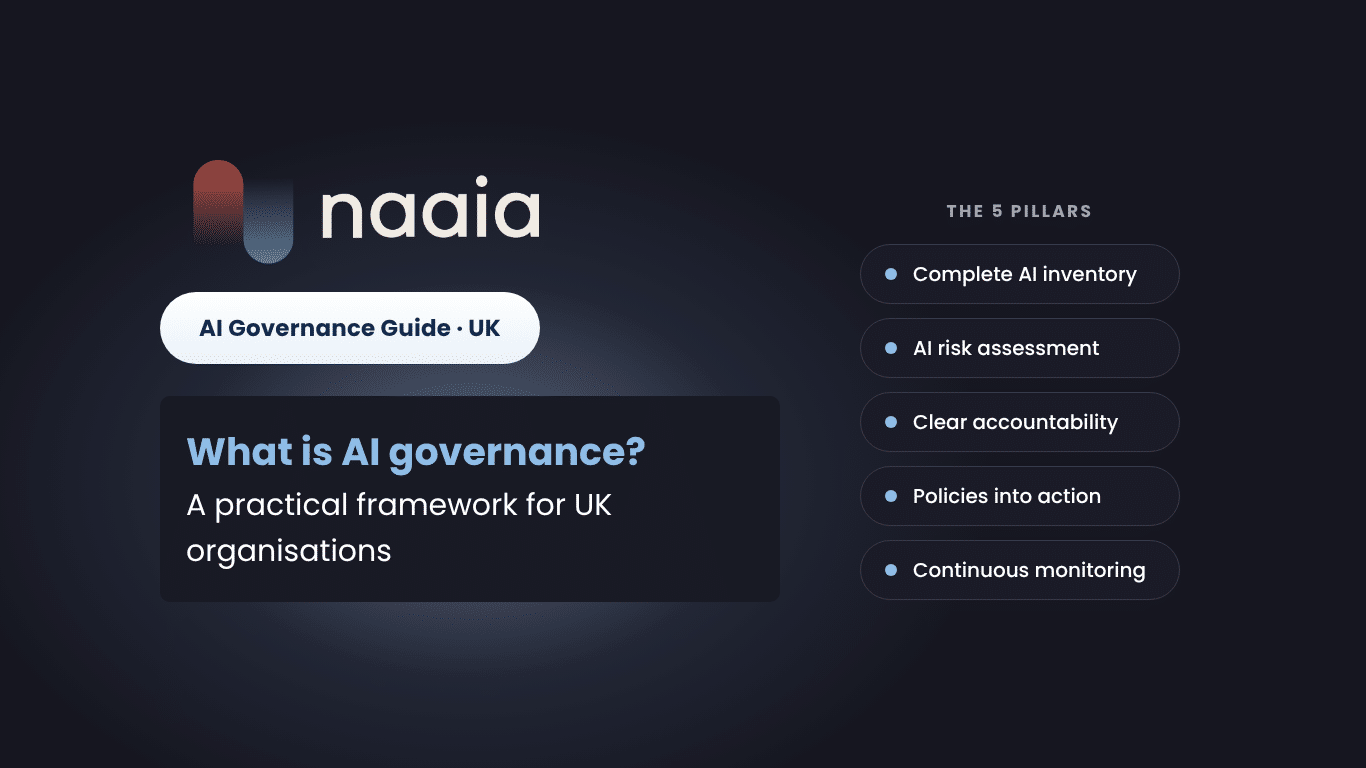
The 5 pillars of effective AI governance
1. A complete AI inventory
You can’t govern what you can’t see. The first step is to map every AI system, model and component, whether built in-house, bought, or embedded in third-party tools. For each one, record its purpose, the data it uses, the supplier, its users and your organisation’s role
2. AI risk assessment and management
Each system needs to be qualified. Is it high-risk under the AI Act? What risks does it pose to fundamental rights, safety, data protection or reputation? An AI risk assessment should cover regulatory risks, as well as internal, technical (robustness, bias, drift) and supplier-related risks.
3. Clear roles and accountability
AI governance is cross-functional. It brings together legal, compliance, risk and data protection teams, IT, data and AI teams, procurement and the business. You need to decide who approves a new use case, who monitors risk, who documents and who has the final say. An AI governance committee, with a named owner for each system, is often the starting point.
4. Policies turned into concrete actions
A responsible AI charter is only worth something if it becomes operational: technical documentation, human oversight, testing, user information and traceability. This is where many organisations get stuck. Regulatory requirements stay abstract and never reach teams’ day-to-day work.
5. Continuous monitoring, not point-in-time audits
AI systems evolve, models are updated and regulations change. An annual audit is no longer enough. AI governance requires continuous monitoring: oversight of systems in production, alerts, metrics, up-to-date audit reports and requirements that update as soon as the law does.
ISO/IEC 42001: the reference framework for your AI governance
Published in 2023, ISO/IEC 42001 sets out the requirements for an AI Management System (AIMS). It gives organisations an internationally recognised method to structure AI governance: AI policy, risk and impact assessment, controls and continual improvement.
It offers two benefits:
- structure: a proven framework, modelled on the approach of ISO 27001 for information security;
- proof: third-party certification that demonstrates maturity to customers, partners and regulators, on both sides of the Channel.
ISO 42001 – the complete guide Learn more
How to build an AI governance framework in 6 steps
- Assess where you stand. Identify which frameworks apply to you (EU AI Act, UK GDPR, ISO 42001, sector rules, internal policies) and your current level of maturity.
- Build your inventory. Map existing and planned AI systems, including AI embedded in suppliers’ tools.
- Qualify and prioritise. Classify each system by risk level and by role then prioritise based on business impact and risk exposure.
- Define your operating model. Appoint owners, set up decision-making bodies and formalise how new use cases are approved.
- Operationalise requirements. Turn each obligation into assigned tasks, with documented evidence and progress tracking.
- Monitor continuously. Oversee systems in production, report through dashboards, train your teams and update your framework whenever regulation changes.
EU AI Act compliance checklist – Read more
Turning AI governance into a source of value
AI governance is often seen as a constraint. The most mature organisations use it as an advantage:
- prioritise AI projects by strategic value, not just by compliance status;
- get to production faster, with a clear approval process that avoids last-minute blockers;
- build trust with customers, partners and employees;
- keep control of the AI supply chain and reduce dependencies.
“Naaia enabled us to move toward a more value-driven approach to AI governance. Beyond compliance, the platform helps us prioritize AI initiatives based on business impact, risk, and strategic value.”
— Tom Oostens, AI Director, Equans
Why spreadsheets and one-off audits fall short
Running AI governance in spreadsheets or through one-off audit engagements quickly reaches its limits. The inventory goes out of date, requirements aren’t linked to systems, monitoring is manual, and every new regulation means starting again.
An AI Management System (AIMS) centralises and automates this work. Naaia, the first European AIMS, is built on three pillars:
- Full visibility: a central registry of every AI system, model and component, with regulatory and internal risk assessment.
- Automated compliance and continuous monitoring: an engine that turns the EU AI Act, GDPR, ISO 42001, the NIST AI RMF or your internal charters into concrete tasks, updated automatically as regulation evolves.
- Interoperability: 100+ connectors to your existing stack (ServiceNow, Jira, Teams, GitHub, Wiz…), with flexible hosting options, including European hosting for sovereignty-sensitive deployments.
“We chose Naaia for its clear framework to inventory and govern our AI initiatives. We particularly appreciate the combination of its user-friendly tools, which make compliance more accessible, and the supportive guidance from their team.”
— Didier Drobecq, Director of Data & AI Information Systems, Bouygues Telecom
Naaia is AFAQ ISO/IEC 42001 and ISO 27001 certified. The platform was built by a team that combines lawyers specialising in AI and data protection with technology experts.
AI governance FAQ
What’s the difference between AI governance and EU AI Act compliance?
EU AI Act compliance merely means complying with all of the EU AI Act’s obligations. AI governance is a broader framework that ensures compliance not only with the AI Act, but also with other regulations, standards and internal policies, while steering the value of your AI projects. Governance involves structuring, within an organisation, all possible uses of AI throughout its entire lifecycle.
Does the EU AI Act apply to UK companies?
It can. The AI Act applies to organisations outside the EU when they place AI systems on the EU market or when their AI systems’ outputs are used in the EU. Many UK organisations will be in scope for at least part of their AI portfolio.
Who is responsible for AI governance in an organisation?
Responsibility is shared between senior leadership, legal, compliance and risk teams, IT, and data and AI teams. It is usually coordinated by an AI governance committee or a designated AI governance lead.
Is ISO 42001 mandatory?
No, it’s a voluntary standard. It is, however, a recognised framework for structuring AI governance and demonstrating maturity.
Where should we start?
With an inventory of your AI systems. It is the prerequisite for any risk assessment or compliance programme.
Move from reactive AI compliance to governed, scalable AI.
