
An AI governance tool holds the inventory of your AI systems, along with their risk assessments, vulnerabilities and compliance gaps. Together, that is the most sensitive map of your digital strategy. Where this data is hosted, and under which law, is a risk-management decision in its own right. For compliance, legal and risk leaders, the tool’s sovereignty belongs on the selection checklist, alongside regulatory coverage.
Your AI registry is a strategic asset
Building effective AI governance almost always starts with an inventory: which AI systems are in use, built or bought, by whom, and for what purpose. Over time, that registry fills up with increasingly sensitive information:
- Strategic use cases, including innovation projects not yet made public.
- The regulatory classification of each system, for example an AI system that is high-risk under the AI Act.
- Risk assessments and their findings: detected bias, robustness weaknesses, cyber vulnerabilities reported by your security tools.
- Compliance gaps and the action plans to close them.
- Supplier dependencies: which models, APIs and providers you rely on.
Taken together, these show your strengths, your weak points and your legal exposure in detail. That is information you protect as carefully as an M&A data room or a GDPR record of processing activities.
Three risks of a non-sovereign tool
1. Extraterritorial laws
Some foreign laws let a country’s authorities demand access to data held by providers under their jurisdiction, wherever that data is stored. Examples include the US CLOUD Act (2018) and Section 702 of FISA. Hosting data in Europe is therefore not always enough. The provider’s nationality and the law that governs the contract matter just as much.
For an AI registry, the risk is concrete: your vulnerability assessments or your list of non-compliant systems could leave your control without you being told.
2. Vendor lock-in and reversibility
You don’t replace an AI governance tool every year. It builds up years of history: assessments, audit evidence, documented decisions and traceability. That record is exactly what a supervisory authority or auditor will ask for. It is also central to post-market monitoring requirements.
So check two things: can you export this data in a usable format, and will the tool stay available if the geopolitical or commercial situation changes? The EU Data Act, applicable since September 2025, strengthens the right to switch cloud providers, a clear sign of how much reversibility matters.
3. A mismatch with the European regulatory framework
AI governance in Europe rests on several texts that work together: the AI Act, the GDPR, the Cyber Resilience Act, harmonised standards and ISO/IEC 42001 (see our article on how the AI Act, CRA and GDPR interact). A tool designed outside Europe and adapted afterwards may treat these texts as checkboxes. It can then miss their shared logic: protecting fundamental rights, scaling obligations to risk and assigning accountability across the whole lifecycle.
Sovereignty is more than where data is hosted
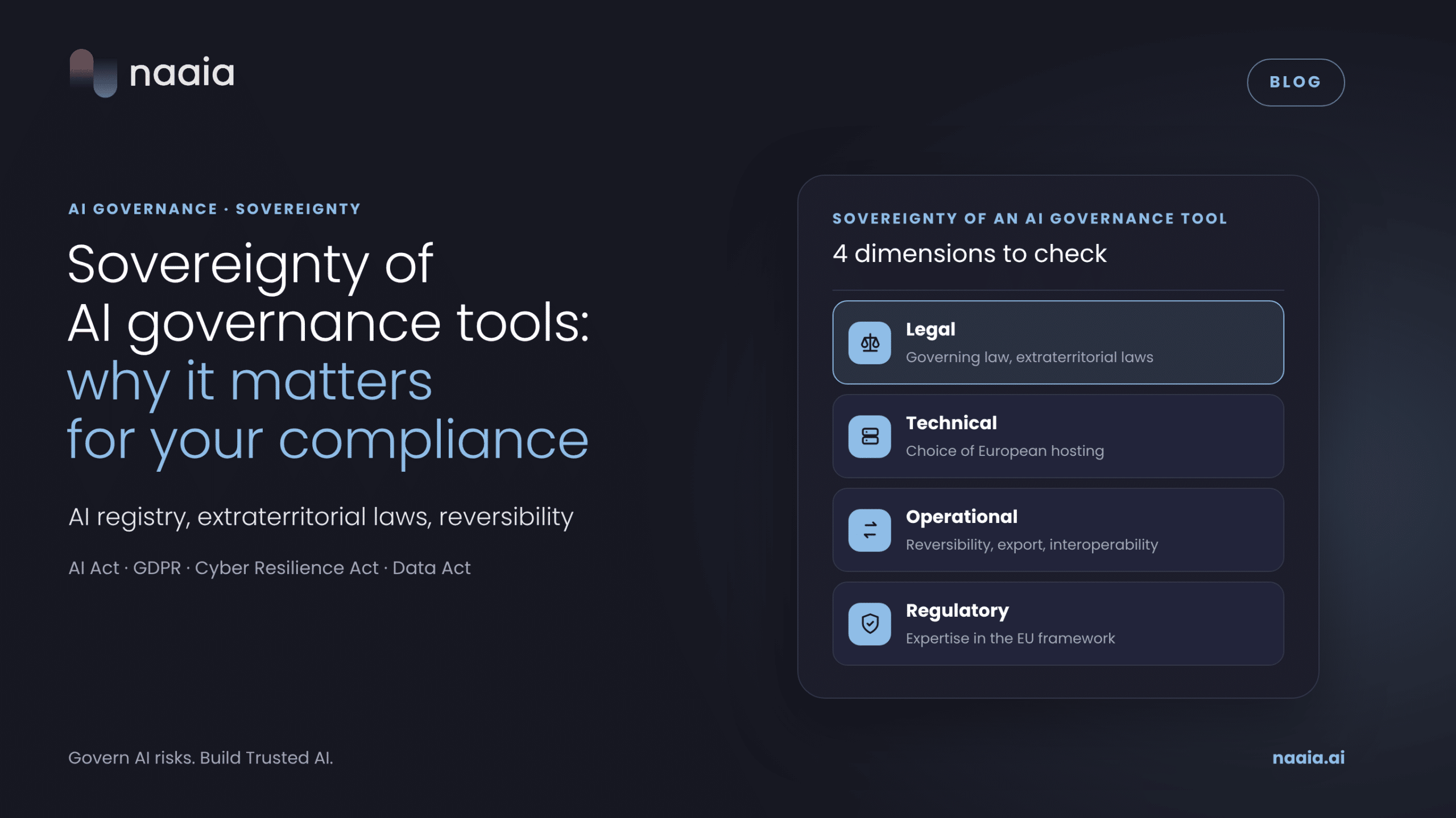
Sovereignty is often reduced to “my data is in Europe.” For an AI governance tool, it rests on four elements:
| Dimension | Question to ask your vendor |
|---|---|
| Legal | Which law governs the contract? Is the vendor subject to extraterritorial legislation? |
| Technical | Where is the data hosted? Can I choose a European hosting provider? |
| Operational | Can I export my registry and audit evidence? Does the tool connect to my existing stack without locking me in? |
| Regulatory | Does the vendor understand the European framework from the inside? Do its updates follow how the texts evolve? |
A solution that answers all four well keeps you in control of your governance, instead of making you dependent on a party you don’t control.
Why sovereignty is a compliance issue
For a compliance team, choosing a sovereign tool is consistent with what it already requires of its own AI systems. The AI Act demands control, traceability and documentation. Managing those requirements with a tool whose jurisdiction and reversibility you don’t control would be a contradiction.
Auditors and regulators follow the same logic: trust in an AI management system also depends on trust in the tools behind it. That is the idea of an AI Management System (AIMS), the model set out in ISO/IEC 42001: governance is not a list of controls but a complete system, tooling included.
Sovereignty is therefore not one more constraint. It is how you build AI governance you can defend in front of an audit committee, a regulator or a customer.
Naaia’s approach: European AI governance by design
Naaia, founded in France in 2022, is the first European AIMS. Several of its choices address sovereignty directly:
- Regulatory expertise from the inside. Three of the four co-founders are lawyers specialising in IT, AI and data protection. Naaia engages regularly with bodies such as the European AI Office, CEN-CENELEC, the CNIL (France’s data protection authority) and the DGE.
- Recognised certifications. Naaia is AFAQ ISO/IEC 42001 and AFAQ ISO 27001 certified.
- Hosting you choose. The platform can be hosted with European providers such as Scaleway or OVH, or in other environments depending on your requirements.
- An open tool, not a black box. More than 100 connectors integrate with your existing stack (ServiceNow, Wiz, Jira, GitHub and more). Your governance runs on your tools instead of locking you into a proprietary ecosystem. Explore our AI registry.
- One engine for every framework. The AI Act, GDPR, CRA, ISO/IEC 42001, NIST AI RMF and your internal charters are handled in a single compliance engine, updated continuously.
Organisations that run sensitive AI systems have understood this:
“Naaia provided the structured, collaborative approach our organization needed to turn complex regulatory requirements into clear, actionable steps for our teams. As a provider of high-risk AI systems, we relied on Naaia as a trusted partner, whose genuine support enabled us to rapidly operationalize our compliance program.”
— Vincent Bouatou, CTO, IDEMIA Public Security
Key takeaways
- An AI governance tool holds the most sensitive map of your digital strategy.
- European hosting is not always enough: the governing law and the vendor’s nationality matter too.
- Being able to get your compliance data back is a matter of auditability and business continuity.
- A tool designed within the European framework applies the logic of the AI Act, GDPR and CRA more faithfully.
Evaluating AI governance tools? See how Naaia combines multi-framework compliance with full control of your data: get a demo.
Govern AI risks. Build Trusted AI.
