
Introduction
AI has moved from pilot projects to everyday operations. Copilots draft documents, chatbots answer customers, models screen job applicants and score credit requests, and AI agents are starting to act on their own. Each of these systems brings real value, and each carries risks that organisations are now expected to understand and keep under control.
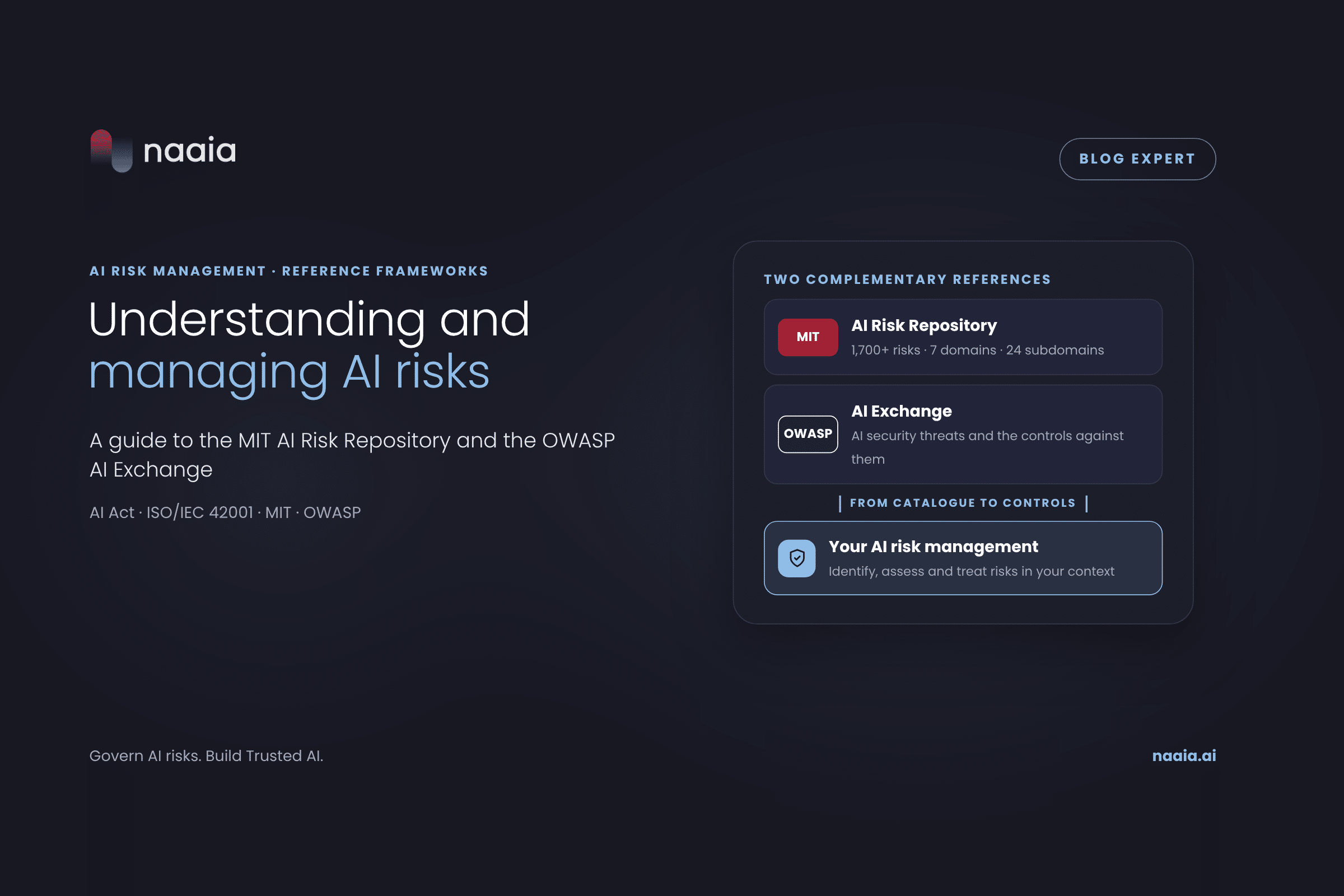
But where do you start? With a wide variety of possible risks, a fast-moving threat landscape and growing regulatory expectations, many teams struggle to know which risks apply to their AI systems and how to address them. Two open, recognised references can help: the MIT AI Risk Repository, which maps the full range of AI risks, and the OWASP AI Exchange, which focuses on the security threats facing AI systems and the controls that counter them. This guide explains what makes AI risks different, why managing them matters, and how to use both frameworks to build an AI risk management approach that fits your organisation.
1. Understanding AI Risks
AI is now embedded in how organisations work, and with it, AI risks are everywhere. AI systems differ from traditional software: they learn their behaviour from data, their outputs are probabilistic and hard to explain, and with generative AI and agents they can now produce content and take actions on their own. They also often run in settings where they directly affect people’s rights, opportunities and safety.
As a result, AI risks are wide-ranging. They include technical failures, security threats such as data poisoning and prompt injection, and broader harms like discrimination, privacy violations, misinformation and overreliance on automated decisions. Their consequences can be legal, financial, operational and reputational. These risks also come from different sources: humans or the AI itself, intentional or accidental, before or after deployment.
In this context, identifying and managing AI risks is no longer optional. This article looks at how organisations can approach it, drawing on two recognised reference frameworks: the MIT AI Risk Repository and the OWASP AI Exchange.
2. Managing AI Risks
Managing AI risks is no longer optional. It is essential for building trustworthy AI and is increasingly a legal requirement. The EU AI Act is the most notable example: under Article 9, providers of high-risk AI systems must establish a continuous risk management system across the entire lifecycle. It isn’t the only one, though. Other regulations, such as data protection rules and sector-specific requirements, also expect organisations to assess and mitigate the risks of the AI they use. Beyond legal obligations, management system standards such as ISO/IEC 42001 place risk management at their core, requiring organisations to assess and treat AI risks as part of their AI governance.
It all starts with an inventory. You can’t manage what you can’t see. Knowing which AI systems are in use, who is responsible for them and which risks they carry is the foundation for everything that follows. From there, organisations put governance and clear responsibilities in place, identify the risks that apply to each system, and extend existing security and development practices to cover AI. They then limit potential impact through access controls, guardrails and human oversight, and demonstrate through testing and documentation that risks are under control.
3. Reference Frameworks
No single framework is mandatory for managing AI risks. Organisations can, however, rely on reference frameworks that give their work a common starting point to identify relevant risks. The MIT AI Risk Repository and the OWASP AI Exchange are two of the most comprehensive. Neither is a legal requirement or a certification scheme. Both are guides that organisations can draw on and adapt to their own context, AI systems and level of maturity.
The two frameworks look at AI risks from different angles. The MIT AI Risk Repository offers a broad catalogue covering the full range of AI risks, from discrimination and misinformation to socioeconomic and safety concerns. The OWASP AI Exchange, on the other hand, focuses on security and privacy risks: the threats that target AI systems and the controls needed to protect them.
Both frameworks are also designed to evolve. As AI technologies advance, new uses emerge and with them new risks and threats. Both resources are regularly updated to reflect these changes. This makes them living references rather than static checklists, and organisations should revisit them as their own AI systems and the risk landscape change.
a) MIT AI Risk Repository: A Reference Catalogue of AI Risks
The MIT AI Risk Repository gives organisations a shared reference for AI risks. It brings together more than 1,700 risks drawn from existing AI risk frameworks and research, each linked to its original source.
For organisations, this means they don’t have to build a list of AI risks from scratch. The repository provides a structured, evidence-based baseline for identifying the risks relevant to their AI systems, whether technical, ethical, security-related or societal. Because it’s a living database, it’s updated regularly as new frameworks and research are published.
The Causal Taxonomy: How, When and Why AI Risks Occur
The first taxonomy classifies risks by their cause, using three factors. The entity factor asks whether a risk is caused by the AI system’s own decisions or actions, or by humans. The intent factor distinguishes between harms that are the expected result of pursuing a goal and those that are unexpected side effects. The timing factor indicates whether the risk arises before deployment, during development and training, or after deployment, once the system is in use.
This view helps organisations decide where in the AI lifecycle a risk needs attention and who is best placed to address it. Risks that arise before deployment fall mainly to data science and development teams. Risks that emerge once the system is in use call for usage policies, access controls and ongoing monitoring.
The Domain Taxonomy: 7 Domains and 24 Subdomains of AI Risk
The second taxonomy classifies risks by the type of harm involved, across seven domains:
- Discrimination and toxicity covers unfair discrimination and misrepresentation, exposure to toxic content, and unequal performance across groups.
- Privacy and security covers the compromise of sensitive information and vulnerabilities or attacks targeting AI systems.
- Misinformation includes false or misleading outputs as well as the wider pollution of the information ecosystem.
- Malicious actors covers the deliberate use of AI for disinformation and surveillance at scale, cyberattacks and weapons development, and fraud and targeted manipulation.
- Human–computer interaction addresses overreliance on AI and the loss of human agency and autonomy.
- Socioeconomic and environmental spans power centralisation, inequality and declining employment quality, the devaluation of human effort, competitive dynamics, governance failure and environmental harm.
- AI system safety, failures and limitations brings together risks such as AI pursuing goals in conflict with human values, dangerous capabilities, lack of robustness, lack of transparency, AI welfare and rights, and multi-agent risks.
This breadth sets the repository apart. Many AI risk resources focus on a single angle, such as security, fairness or safety. The MIT taxonomy brings them together in one structure, so organisations can see their full risk exposure rather than a single slice of it.
Among these risks, the repository highlights the areas experts consider most concerning over the next five years: cyberattacks, weapon development and mass harm; power centralisation and unfair distribution of benefits; pollution of the information ecosystem; disinformation, surveillance and influence at scale; AI possessing dangerous capabilities; and loss of human agency and autonomy.
Combining Both Taxonomies
The two taxonomies can be used separately or together. Teams can filter risks by lifecycle stage to build a monitoring plan, or by domain to focus a review on a specific type of harm. Crossing both views shows whether the risks in a given domain tend to come from the AI system or from people, and whether they are deliberate or accidental. That insight points directly to the type of measure needed: technical safeguards, human oversight or usage policies.
From Catalogue to Risk Management
In an AI risk management process, the MIT AI Risk Repository can serve as a catalogue for risk identification. It gives organisations a structured inventory of AI risks to screen their AI systems against, so they can check that no category of harm is overlooked. Its two taxonomies make the catalogue easy to navigate: by cause, to understand where and when a risk arises, and by domain, to understand the type of harm involved. It also gives legal, compliance, data and business teams a common language. Because each risk is grounded in recognised research, the catalogue strengthens the documentation expected under the EU AI Act and ISO/IEC 42001. It also provides a solid basis for the assessment and treatment steps that follow.
b) OWASP AI Exchange: A Reference Framework for AI Threats and Controls
The OWASP AI Exchange focuses on AI security. It gives organisations a reference of the threats facing AI products and the controls that protect against them. While other frameworks cover the full range of AI risks, the AI Exchange concentrates on keeping AI systems secure: protecting their data, models and behaviour against attacks and misuse.
It applies to all types of AI, across development and runtime, and is aimed at security, engineering and governance teams. It is a body of good practice, not a checklist or a certifiable standard, so organisations select and adapt the controls relevant to their own AI systems.
What Attackers Want: Disclose, Deceive, Disrupt
The AI Exchange looks at threats through what an attacker is trying to achieve. Some attacks aim to disclose, extracting confidential training data, user inputs or the model itself. Others aim to deceive, manipulating the model so it behaves in unintended ways, such as making wrong decisions or following hidden instructions. Others aim to disrupt, making the AI unavailable or too costly to run. This framing helps organisations connect technical threats to business impact: a data leak, a manipulated decision or a service outage.
Four Parts: From General Controls to Runtime Threats
The AI Exchange organises its guidance into four parts, each linking threats to concrete controls:
- General controls apply to every AI product. Governance controls bring AI under organisational oversight by integrating it into existing security and development programmes, ensuring legal compliance and training teams. Data limitation controls keep only necessary data, and they anonymise or delete it once it is no longer needed. A third set of controls limits the effects of unwanted AI behaviour through human or automated oversight, restricted permissions, transparency and continuous checks on reliability and bias.
- Input threats are attacks carried out through what is sent to the AI. In a prompt injection, for example, hidden instructions in an email or web page lead an AI assistant to leak data or take unwanted actions. Other input threats include evasion with crafted inputs, disclosure of sensitive data in outputs, model theft through repeated queries, and resource exhaustion. Controls include usage monitoring and rate limiting, filtering of malicious inputs and sensitive outputs, adversarial training, and clear separation between untrusted content and legitimate instructions.
- Development-time threats target AI while it is being built. A poisoned dataset or a compromised pre-trained model downloaded from a public repository can plant hidden behaviour that only shows up once the system is deployed. Leaks of training data, models or code are also a concern at this stage. Controls focus on securing the development environment, segregating sensitive data, checking data quality and managing third-party models, datasets and components.
- Runtime threats call for conventional security applied to AI in production. This means protecting deployed models from tampering and theft, securing user inputs and augmentation data such as RAG knowledge bases, system prompts and agent memory, and encoding outputs to neutralise malicious code. AI agents get particular attention, because they can act on their own and use tools. It involves limiting their privileges, checking every tool call against the agent’s task and running each agent in an isolated sandbox, so that a compromised agent cannot affect the rest of the system.
From Threats to Risk Treatment
In an AI risk management process, the AI Exchange is a strong support for risk assessment and treatment. It helps organisations identify the security threats that apply to their AI systems and choose proportionate controls, with each decision linked to a specific threat and the measures that address it. That traceability is also what regulators and auditors increasingly expect. Its focus is also its boundary, though. The AI Exchange concentrates on AI security, so wider societal and ethical risks still need to be managed by other means.
4. Conclusion: Combining References for Effective AI Risk Management
AI risks are broad, varied and constantly evolving, and no single framework covers them all. The MIT AI Risk Repository and the OWASP AI Exchange offer complementary perspectives. The first helps organisations identify the full range of risks their AI systems may raise, from discrimination to safety. The second helps them protect those systems against security threats with concrete controls.
Neither framework is a ready-made solution, though. They are references to draw on, not assessments to copy. Organisations should adapt their risk assessments to their own context: the AI systems they use or develop, their purpose and level of autonomy, the data they process, the people they affect, their regulatory obligations and their level of maturity. The same risk can be critical for one organisation and marginal for another. Only an assessment grounded in that context can set the right priorities and lead to proportionate controls.
Because AI and its threats keep changing, risk management is not a one-off exercise. It is an ongoing process, revisited as systems evolve, as new uses emerge and as these references are updated.
For organisations, the challenge is less about finding the right references than about putting them into practice in a way that is tailored to their context, consistent, traceable and scalable.
