
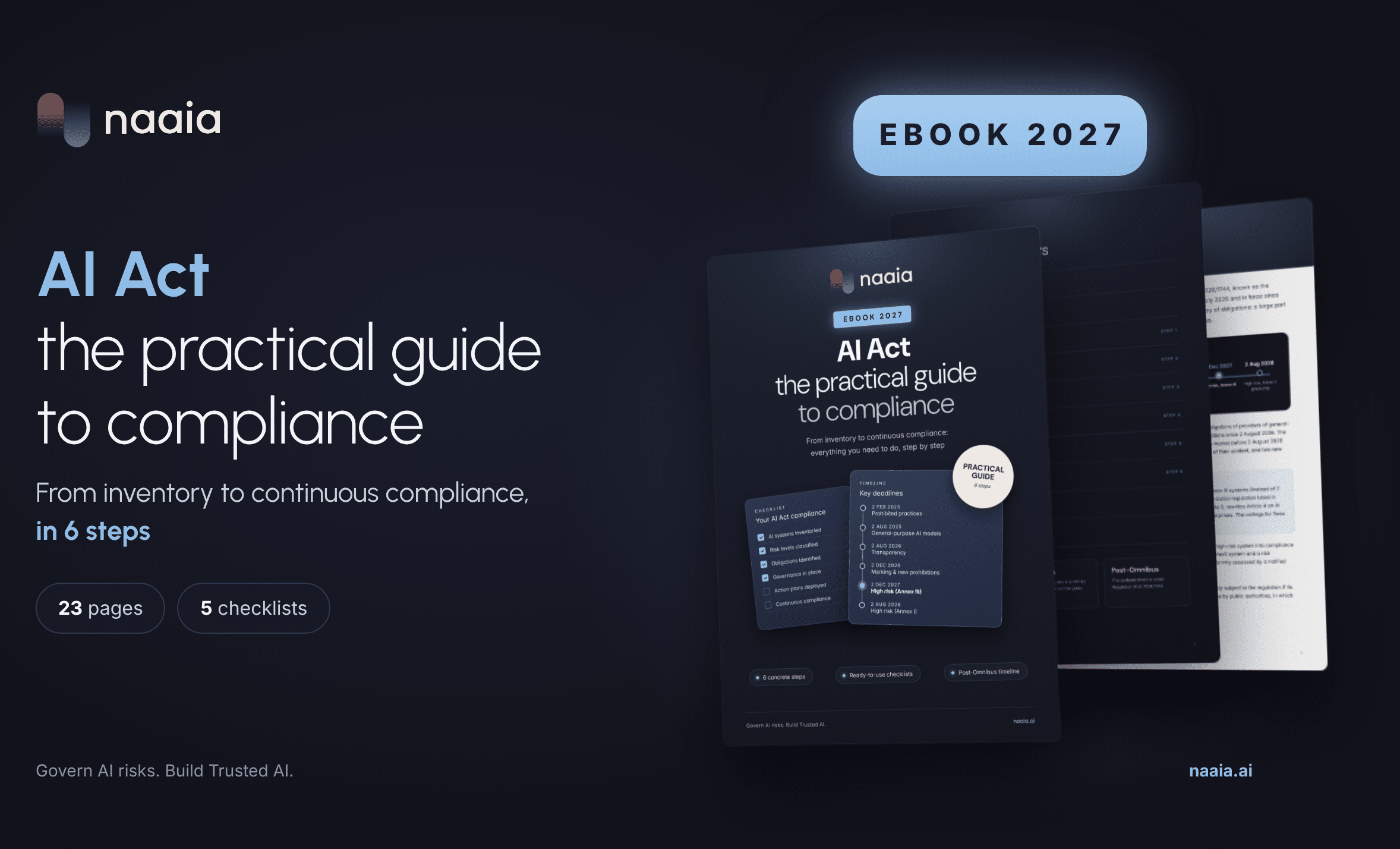
AI Act compliance comes down to 6 steps: map your AI systems, classify them, identify your obligations, organise your governance, roll out your action plans and ensure continuous compliance. Written by Naaia’s regulatory team, this 21-page guide gives you the method, the timeline updated after the AI omnibus and ready-to-use checklists.
Download the ebook!
- Written by our regulatory experts
- Put into practice by all our clients
- Practical checklists for straightforward compliance
Why AI Act compliance can’t wait
The AI Act (Regulation (EU) 2024/1689) is no longer a distant prospect. Since 2 February 2025, certain AI practices have been prohibited in the European Union. Since 2 August 2026, people must be told when they are interacting with an AI system. And obligations for high-risk systems now have fixed dates: 2 December 2027 for Annex III systems, and 2 August 2028 for those embedded in regulated products.
The AI omnibus (Regulation 2026/1744) postponed these deadlines, but a delay is not a reprieve: bringing a high-risk system into compliance takes several months, between documentation, testing and the quality management system.
For many organisations, the challenge is not understanding the spirit of the regulation. It is knowing where to start: which systems are in scope, which obligations apply, who must do what and how to prove it.
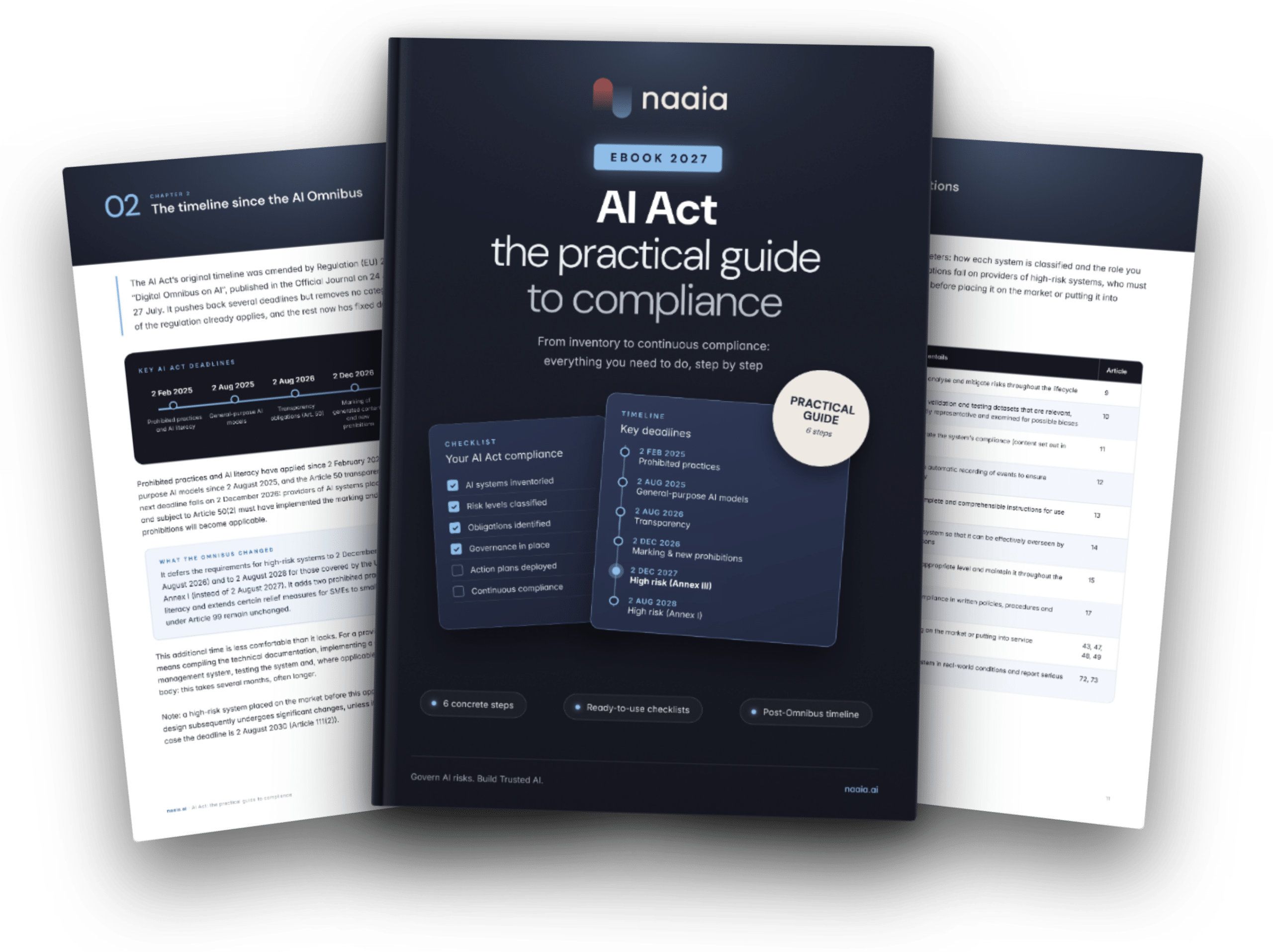
What this AI Act guide covers
The AI Act at a glance
The risk-based approach, the scope and the roles: provider, deployer, importer and distributor.
The timeline after the AI omnibus
Key deadlines from 2025 to 2028, and what the omnibus changed.
The 6 steps to compliance
- Map your AI systems: developed in-house, purchased or embedded in your software, with a template record.
- Classify each system: prohibited practices, high risk, transparency, with a table of examples.
- Know your obligations: depending on your role, for general-purpose AI models, and what the EN 18286 standard brings.
- Build your governance: roles, AI policy, AI literacy and ISO/IEC 42001.
- Roll out action plans: prioritise, assign, keep the evidence.
- Ensure continuous compliance: monitoring, regulatory watch, indicators and audits.
Penalties and risks
The three tiers of fines set out in Article 99, up to €35 million or 7% of total worldwide annual turnover, and the risks beyond penalties.
An AI Act summary checklist
Ten points to take stock of your compliance.
21 pages · 6 steps · 4 checklists · post-omnibus timeline
Who is this guide for?
Compliance, legal and risk teams, data and AI teams, and DPOs who need to lead their organisation’s AI Act compliance without being specialists in the regulation.
They already trust us
“Naaia helped us operationalize AI Act readiness across our regional authority’s services with a clear and trusted governance framework. The platform improved collaboration between departments and gave us the visibility needed to scale AI responsibly.”
— Nathalie Buffotot, Director of Data Compliance Projects, La Région Île-de-France
AI Act compliance FAQ
What is the AI Act?
Regulation (EU) 2024/1689 is the first comprehensive legal framework on artificial intelligence. It classifies AI systems by risk level and sets proportionate obligations.
When does the AI Act apply?
It entered into force on 1 August 2024 and applies in stages: prohibited practices since February 2025, general-purpose AI models since August 2025, transparency since August 2026, and high-risk systems in December 2027 and August 2028.
What did the AI omnibus change?
It postponed the obligations for high-risk systems and simplified certain requirements, such as AI literacy. It changed neither the prohibitions nor the penalty ceilings.
Does the AI Act apply to my organisation?
Yes, as soon as it develops, buys or uses an AI system in the European Union. Its obligations depend on its role and on the risk level of each system.
Where should we start?
With an inventory of your AI systems, including those embedded in your software. It is the first step of the guide.
Want to move faster? Naaia, Europe’s first AIMS®, supports each of these steps on a single platform. AFAQ ISO/IEC 42001 and ISO 27001 certified.

Govern AI risks. Build Trusted AI.